Wednesday, 23 September 2015

Reach for the stars... No, not like that!


Something that I have noticed as a teacher is that we keep telling those that we teach that they can be anything, do anything and achieve anything. We have been taught to motivate them to become the best they can be, and never to give up on their dreams. We have encouraged them to make goals and stick to them. However, we have never told them how.

At the start of this year, I asked the learners in my Grade 8 register class to make posters about what they want to be when they grow up. I got back one poster saying "social worker" and one saying "epidemiologist"... all the others wanted to be lawyers or doctors. They have been given the idea that lawyers and doctors are successful, and so most of them want to become these successful people who make a lot of money.

The funny thing is though, the majority of the girls who wrote the generic "doctor" or "lawyer" very seldom work in class. They are on the verge of failing, and they don't seem to care about anything more than talking to their friends and trying to get away with wearing lipstick in class. 

A few weeks ago, I asked them to write down again what career they want to have. This time, I followed it up with a question: What do you need to do to become this person? Suddenly, I had a number of blank faces staring at me. I asked them if they need training of any kind. I asked them if they need to go to a university or a college or go through an apprenticeship. I had people putting up their hands and asking me if they needed to go to a university to become a lawyer, and what degree they needed. There was one girl who was different and wanted to become a digital designer or something like that... I told her that I believe she would need to go to a college, but the rest all needed university degrees for what they wanted. They had never known this before.

Then I asked them what they needed to be accepted into a college or university. Again, blank stares. They had all been under the mistaken impression that if they want it, it will come to them. If they want to become doctors, a degree in medicine will land in their laps without doing anything. If they were aware that they needed to get into a university, they didn't realise that there were requirements for that, including getting good marks at school.

I explained to them that for medicine, you need to have maths as a subject, not maths literacy. I told them that next year in Grade 9, they will write an entry test for maths. If they fail that, they can only do maths lit, which means that they will not be able to become doctors. Suddenly I had a number of girls looking shocked and asking how they can pass it. I said simply that they need to start working now.

This appears to be what is missing in all of the motivational speeches that we give these children. We tell them that they can be anything they want in this world, but we neglect to tell them how: by working hard.

We tell them that they need to make goals in life, but we neglect to tell them how to achieve those goals: by working out each step of the way.

My husband recently did a course through Brigham Young University, in which they spoke about SMART goals. I had learned about these when I was in school, and this reminded me of the importance of planning our goals properly. When we make goals, we need to do so by figuring out each step of the way.

S: specific -- Be specific about what you want to achieve. My husband's instructor said that they should be so specific that they feel stupid. This may seem unneeded, but the details are what will help you to achieve your goal.

M: measurable -- You need to be able to measure your progress. For these learners, they can measure their progress towards getting into a university by seeing their results improve as they work hard.

A: attainable -- Don't be stupid... You are not going to sprout wings and fly, so don't aim for something that is impossible. It should be something that you are capable of achieving.

R: realistic -- It's not realistic to think that you are going to be a qualified doctor by the time you are sixteen years old, or even twenty years old. Think carefully about what you want, and think about what is realistic.

T: time-bound -- Every goal should have a time attached to it. When do you want to achieve this goal?

"I want to become a doctor" is not exactly timely. "I want to be qualified as a General Practitioner at the University of Cape Town by the time I am 26" is both specific and timely. "I want to be qualified as a General Practitioner at the University of Cape Town by the time I am 26, and this means that I need to achieve at least 80% for all of my subjects in Matric" is also measurable. You can measure your marks and see how you are doing in reaching your goal.

This is something that these children have not been taught. They have been told that they can do anything, but nobody has ever bothered explaining to them that they have to work to do anything, and that it will not just happen. Unfortunately, in this country, there is an attitude of entitlement among many of the youth. They feel that they deserve something, and expect to be given it, without having to do anything first. We need to start teaching them that life is about more than just getting what you want. It is about working for what you want. This requires a change in attitude.
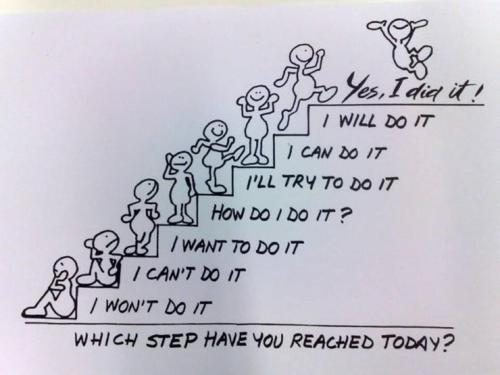
There are steps towards every goal, and it starts with a desire to achieve it. If you look at the diagram on the right, you will see that many of these chilren are on the third step: "I want to do it." They still have five more steps to go, and the very next step is figuring out how to do it. If we neglect to teach them how, they will never reach the final step, no matter how much we encourage and motivate them. Granted, they need to take the steps themselves, but we can at least show them what those steps are. Let's stop blindly telling youth that they can achieve whatever they want, and start telling them that they can achieve whatever they work for. That is the lesson they need.

Saturday, 12 September 2015

Can we recognise our talents and still be humble?


I am grateful to know that I have been blessed with many talents in my life. I can sing, dance, play the piano, and teach. When I was young, however, I often used to wonder if it was appropriate for me to show these talents off, or to be proud of them. I had always been taught that we should be humble and not prideful. On the other hand, I had been taught that we should let our lights shine and that we should use and multiply our talents. I was always in confusion about what attitude I should have. If I were proud of my accomplishments and my talents, was I doing something wrong? Was I lacking humility? If I were to hide these things, was I failing to use and develop my talents? Was I hiding my light under a bushel?

As I have thought about these questions, I have come to realise that perhaps we need to rethink pride and humility. We've always been taught that if you are prideful, you put yourself higher than others, and when somebody has asked what humility is, they invariably get told that it is the opposite of pride.

I would like to expand on these definitions. Pride is not simply putting ourselves higher than others. Rather, it is a self-centred attitude in which we think we can accomplish everything on our own.

Humility, on the other hand is a selfless attitude that is borne of gratitude for all that we have. Rather than believing that we can accomplish everything on our own, we recognise that everything we have is a gift that should be shared. I love this quote from Gordon B. Hinckley, which perfectly shows what humility is all about: “Being humble means recognizing that we are not on earth to see how important we can become, but to see how much difference we can make in the lives of others.”

So often, we are of the attitude that if we want to be humble, we should put ourselves down. However, if we spend all our time focusing on putting ourselves down, we are becoming pridefully self-centred. I read somewhere that humility does not mean that we put ourselves down, but that we recognise that we are part of a bigger plan. If we keep our attention on that bigger plan and try to understand our part in it, we will find ourselves becoming less selfish and more selfless.

Where does all of this fit with our talents? A prideful attitude means that we believe we have accomplished everything on our own, while a humble attitude means that we recognise that those talents we have are gifts from a loving Heavenly Father. As we realise this, we will begin to have a desire to make the most of them and share them with others.

If we look at the parable of the talents, as shared in the book of Matthew in the New Testament, we see a master giving three of his servants a portion of money each before going away for a time. A talent was a very large amount of money, and the three servants received an amount suited to their abilities (Matthew 25:15).

While he was gone, two of the servants traded and invested and managed to increase their money. When their master returned, he congratulated them and rewarded them. The third servant, however, was scared of his master. He decided that, to avoid the risk of losing his portion, he would hide it in a safe place so that he could return it when his master arrived back. When the master returned, he was angry with this third servant because he had done nothing with his money. He asked him why he had not at least invested it -- he wouldn't have had to do anything, but it still would have increased. As a result, the master took the third servant's money away from him and gave it to one of the other servants, who had proven that he would be wise with it.

How often are we like the third servant?

  • He may have asked, "I already have more than I need, so why do I need to increase it?" We ask, "I already have the talent, so why should I take lessons?"
  • He may have said, "People invest because they don't have enough to start with. I do, so I don't need to invest." We say, "Practising is for people who have no talent. I already have the talent, so I don't need to practise."
  • He may have thought, "Even though I have some money, there are others who have more. What if they make fun of me for how little I have?" We say, "If I tell people that I have a talent, they might ask me to show them... What if they are better than me and make fun of me?"
  • He may have questioned, "If I go to the money traders and show them what I have, aren't I showing it off? Aren't I drawing attention to myself? Maybe I should just leave it so that people don't know." We ask, "Aren't I flaunting my talents if I tell people about them or if I perform? Won't that seem prideful? Maybe I should just sit back and watch the others."

... And as a result, we end up burying our talents. We either think we do not need to improve, or we are too scared to show that we have talents. The end result is the same, either way: when our Master, who gave us these talents, returns, He will be angry with us for not using what He gave us, and He will take them away.

If we look at these excuses, all of them are self-centered. Even the last excuse, which appears to be borne of humility, is more focused on looking humble than on blessing the lives of others.

Thus, as we make excuses, we do so out of a form of pride. Therefore, if we truly want to become humble, we need to change our attitudes. We need to embrace and develop the talents we have been given -- indeed, that we have been blessed with.

However, we can also find ourselves being prideful as we do share our talents. Therefore, we should always remember from whence our talents come. If we find ourselves focusing on how much we have done, we need to reconsider how we view our talents. On the other hand, if we always remember that we were given the talents, strengths and opportunities, we are on our way towards humility. Ask yourself, "Am I doing this to get attention or to bless the lives of those around me?"

A friend of mine said that humility is not putting ourselves down, but rather elevating ourselves to understand God's will. As we try to emulate Him, we will find that we are less focused on ourselves, and more focused on a charitable love for others. This will help us to develop the right attitude.